Mindfulness of Body

Transitioning from a Busy Mind
- When transitioning from a busy or active state of mind, gently observe where you feel it in the body and in the breath. Embrace it without trying to suppress or push it away. Observe and welcome the restlessness without judgment. In doing so, you allow it to settle on its own.
- When we notice the busy mind happening, we are being “mindful” and at that very moment. The restless rumination may continue in the background, but it no longer has that same power over us. We can observe it moving through our bodies like ephemeral clouds.
- Just as in quantum mechanics, where observation can change the behavior of light, observing your mental/physical/emotional state as felt sensations will shift the energy. It simply can’t stay the same as the quality of attention changes.
Introduction to Body Scanning Meditation
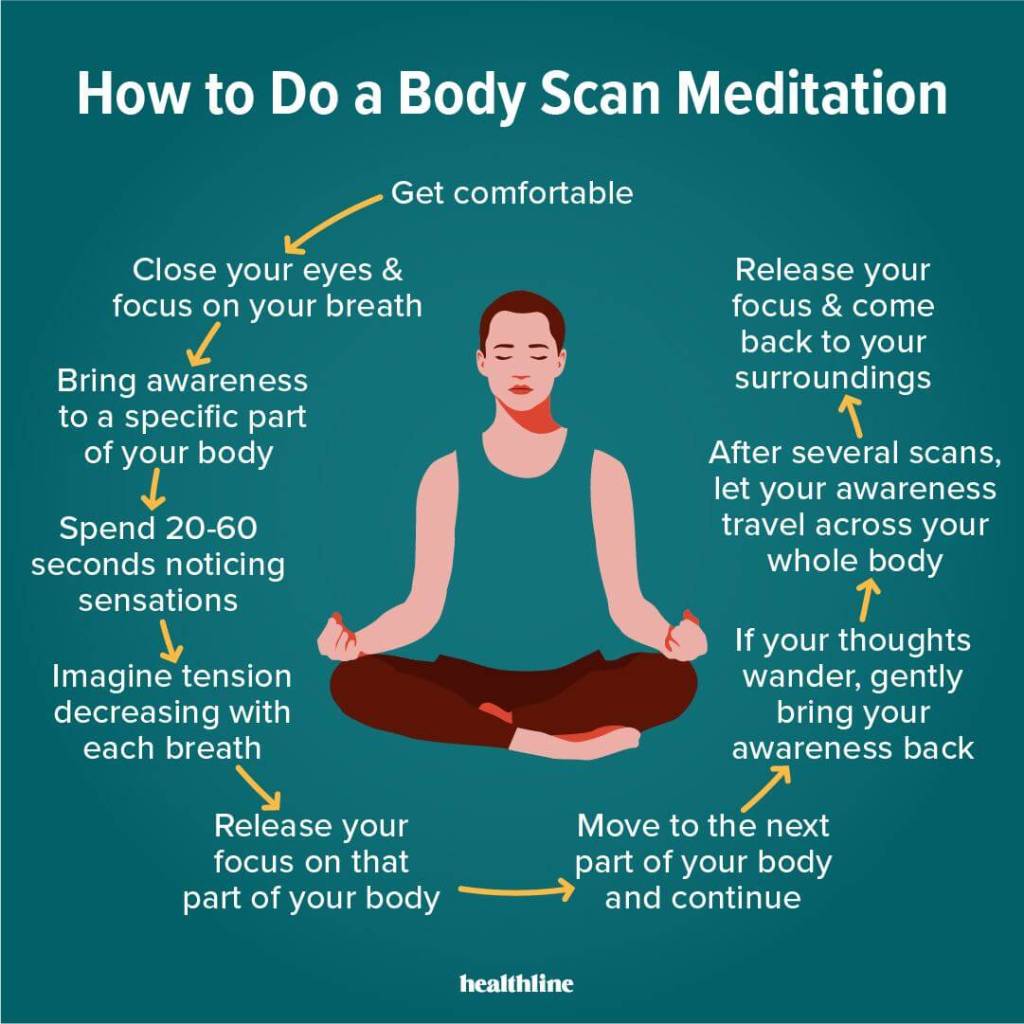
- Body scanning or sweeping, rooted in the Buddha’s teachings of mindfulness of the body (kāyagatā-sati), is a wonderful practice for when the mind is restless.
- As with observing the breath without judgment, apply the same approach to bodily sensations. Observe without attachment to pleasant, unpleasant, or neutral sensations. Recognize that bodily sensations are in constant flux, reflecting the impermanence of the body, a dynamic and ever-renewing entity.
- Focus on the felt awareness of physical sensations rather than conceptualizing the body. This practice involves truly feeling parts of the body without imposing opinions or concepts about them. For instance, you may have a concept of your hand, or opinions about it – it’s large, small, round, or square. But what does your hand actually feel like?
| Experiencing felt awareness: Take a moment and close your eyes, raise your hand in the air and feel your thumb, now feel each finger individually. Now sense the back of the hand, then the palm of the hand. That’s the felt awareness of your hand, which can be quite different than the concept of your hand. Notice how parts of the hand “come into existence” the minute you put your awareness there. |
The Goal of Body Scanning : Awareness of the Impermanent Body
- In the mindfulness of body practice, the goal is to develop awareness of the impermanent nature of bodily sensations.
- The Buddha called this “awareness of the body in the body” and taught it as a foundational practice paving the way for more difficult levels of awareness such as mindfulness of thoughts or emotions. It refers to the idea that the body is not a solid, unified thing, but comprised of many disparate and ever changing parts – many bodies within a body – the nails, teeth, skin, bones, hair, organs, phlegm, blood, 86 billion neurons, etc. – these are all smaller “bodies” in a larger entity.
- Interoception, the ability to sense internal physiological states, is a skill that can be strengthened through body scanning meditation. This increased awareness enhances the mind-body connection, which is crucial for emotional regulation, resilience, creativity, and problem-solving.
Guided Meditation (Mindfulness of Body, 15 min):

Creative Exercise:

After completing the mindfulness of body meditation, let’s bring this lovely energy to a short creative exercise. You can get your pen and paper or any mark making tool.
The idea of this practice is to open that mind-body channel through free form doodling, to connect with your intuitive side and allow it to flow through your mark making as freely as possible. Using the non-dominant hand, we’ll create marks representing the felt sensations in the body, from our feet to the top of our heads.
- Use your non-dominant hand and release any expectations you might have about the outcome. We will now scan our bodies from the bottom of our feet to the top of our heads, noticing the felt sensations and channeling these sensations in the marks on the paper. Don’t try to draw the concept or image of your body, draw the pure sensations only.
- Start at bottom of the paper and bring your awareness to your feet and toes, now draw the sensations in our feet – whatever textures, marks, or shapes that come to mind as you connect with your feet. You may want to do each foot separately if they feel very different. If you don’t feel anything, simply make a mark that represents the absence of feeling.
- Now move up your legs and draw the sensations in your legs. You can move up your paper too. Don’t think about it too much, just channel the felt sensations onto paper as directly as possible.
- Now move up to your stomach and draw the sensations there.
- Now move up to your chest and heart area and draw the sensations there.
- Now move up to your face and head area and draw the sensations there. Focus on the physical sensations you are noticing there.
- Now go to the top of your head and draw any sensations you can feel there.
- Finally, breath into your whole body and draw the felt sensations of breathing into the whole body.
For those interested in trying a longer session, check out this wonderful 30 minute guided body scan meditation from Jon Kabat-Zinn:
 The Universe in a Dewdrop