Mindfulness of Thoughts
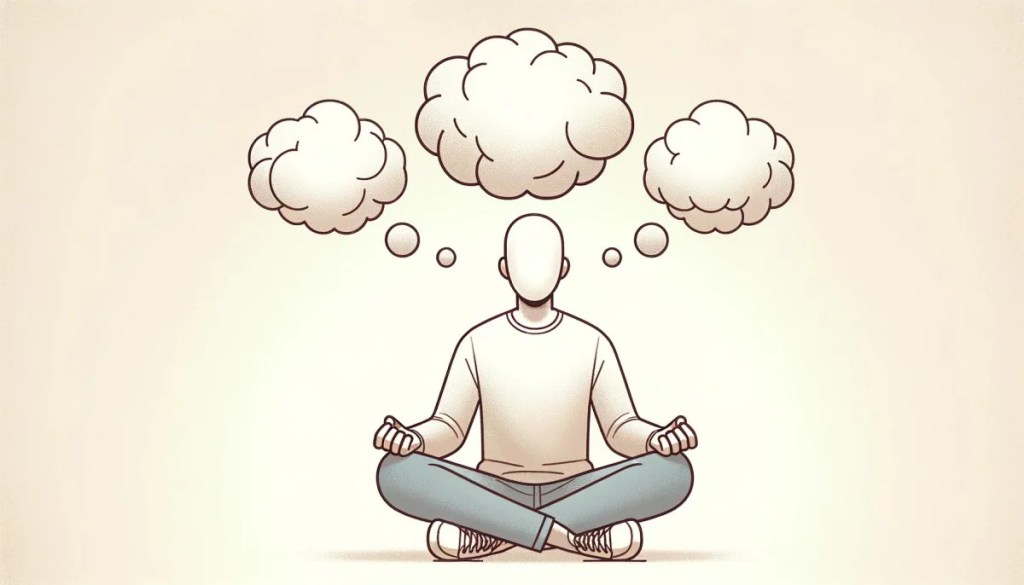
What’s going on with our thoughts?
When observing our thoughts, the first thing we might notice is that they are constantly changing. That may seem at odds with how we actually experience the day to day as most of us carry a sense of self that seems constant and stable.
Upon closer inspection, an illusion is revealed- the sense of self is quite unstable and constantly shifting!
Mindfulness reveals the changing nature of mind (thoughts, emotions, sensations) in more granular detail. It allows us to observe how we constantly construct meaning out of a constant flow of changing phenomena.
You can see how the self is constantly made and remade, like a movie where you are the central character. Mindful awareness turns up the resolution so you can see the construct of it all. A bit of space opens up so you are no longer identifying with the character of self in your movie –but observing how the mind is establishing the scene, projecting meaning onto people, places, and things, and writing the lines you are about to perform, etc.
| “The mind secretes thoughts the way the salivary gland secretes saliva.” -Jack Kornfield |
Where do thoughts come from?
In the Buddhist literature, we get a detailed breakdown of the experiential processes that give rise to our thoughts and the resulting sense of self that is so defined by our thoughts.
These processes are organized into six “sense gates” or “sense consciousness” that give rise to our thoughts and sense of self:

SIX SENSE GATES:
1.EYE 2. EAR 3. TONGUE. 4. NOSE 5. BODY 6. MIND
Here’s the summary breakdown of how these work:
- External stimuli encounter the six senses. This is happening constantly, regardless if we are awake or asleep, aware or unaware.
- This produces an immediate reaction within us that falls into 3 categories: positive, negative, or neutral. These are called the “vedana” in Pali (the Buddhist language of the teachings), or “feeling tones.”
- The thinking mind (6th sense gate of mind) steps in and creates meaning out of it all with a constant flow of thoughts in the form of labels, ideas, beliefs, and stories that reflect the feeling tones associated with the sense phenomena. For instance, a positive reaction at the sense gate may generate a positive/craving thought: “That ice cream tastes good. I want more ice cream.”
- The arising narratives, beliefs, sensations continue to coalesce into a sense of self, over and over. The self may seem stable, but is in fact highly dynamic, unstable, and constantly changing, often at the mercy of our many reactions at the sense gates.
The continuously arising sensation of “self” is possible to observe with mindful awareness. With practice, we can “wake up” to it and see through the construct, thus giving us the freedom to react wisely and compassionately instead of reacting unconsciously.
Tips for practicing mindfulness of thoughts:
Observe the arising, persistence, and disappearance of each thought. You are not your thoughts. You don’t need to try to quiet them or force them to be a certain way. A quieter mind is not necessarily “better” as it might only signify a repression of thoughts. See if you can simply observe the thoughts arising and passing, without judgement or entanglement.
Try to observe the moment before it arises. When you are able to observe thoughts coming and going, see if you can observe the quiet pauses in between thoughts and the moments right before they arise. When something is just about to arise in the mind, before you could say it or label it in words, a particular “feeling tone” (positive, negative, neutral) is already there. See if you can observe this pure sensation before thought steps in to label it.
Get curious about the arising and passing of your thoughts. For creatives, greater awareness of the thinking mind and how it filters and creates meaning at the sense gates is a great skill to have. A greater mindfulness of thinking will allow you to bring creative thoughts into greater focus and to notice the extraordinary in the ordinary. With practice, you will gain greater freedom in how to actively channel your thoughts into a creative process.
End the wars. Thoughts can serve us in amazing and beautiful ways, but they can also constrict and imprison us. Hiroo Onoda was a Japanese imperial officer who spent nearly 30 years in the Philippine jungle, believing WWII was still going on. He was finally persuaded to surrender in 1974 when his former commander finally found him, informed him the war was over, and gave him an order to stop fighting. What are the wars you are fighting internally? What are the repeating cycles of thought that no longer serve you?
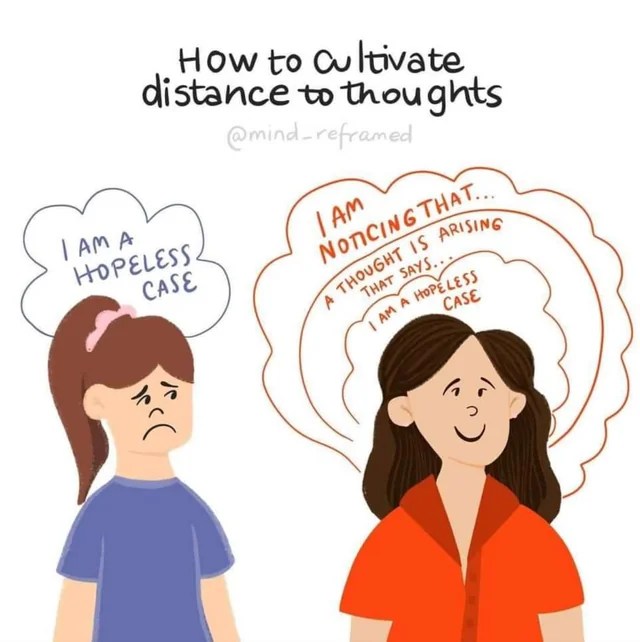
Guided Meditation (Mindfulness of Thoughts, 13 min)

Creative Exercise “Sensing Through a Creative Project” (instead of “thinking through” a project)

- Call to mind a creative and challenging project you would like to see through to completion.
Take a moment to visualize the project from beginning to end and connect with the embodied feelings that come up with each phase of the project.
- Start with where the project stands now, at this present moment. If you haven’t started yet, it may be the feelings of anticipation and excitement. If you have just started, it might be the nervousness or joy of having started and the feelings you have about the imminent progress.
- Try to connect with the felt sensations of working on it and take a moment to visualize things going really well, you are overcoming the challenges of the project, you are getting into a creative flow state and the energy is flowing freely and spontaneously.
- If you are working in a team or with others, imagine they are in this state of flow as well, you are bouncing that positive energy around, sharing it and growing the work.
- Visualize the project developing and coming to fruition… you are letting go of mental and emotional obstacles and just immersed in the flow of the project as it develops… what does that feel like in the body?
- And finally, visualize you have finished your project, and it is even better than you had hoped it would be…what does that feel like in the body? gratitude, joy, surprise, relief?
2. Now replay that movie from beginning to end and draw the textures, shapes, and patterns of the embodied feelings.
This is your map of intention. Intention guides thoughts and actions. You can post the final drawing up, as a reminder of where you’d like to go. When you get into a thought loop, you can return to this image and the embodied feeling… as a reminder you are not your thoughts and there are many other ways to work, feel, and breathe through a project. You can always recognize, allow, investigate, and nurture thoughts to redirect them in a positive direction.
Here’s a great 5 minute explanation on the nature of thoughts, from Jon Kabat-Zinn, “Your Thoughts are Bubbles”:
 The Universe in a Dewdrop