Metta “Loving Kindness” & the Inner Critic

The Inner Critic as a Key Obstacle for Creatives
A very common obstacle to creative work is the inner critic – the negative and critical self-talk that takes one right out of the creative flow that is free, playful, and spontaneous. Don’t beat yourself up if you have an inner critic. We all do! Many people are so harsh with themselves even though they may be generous and accommodating towards others. Let’s see how mindfulness can help.
When does the inner critic appear?
From small things to big things, the inner critic of negative self-talk creeps up all the time without us even noticing it. It’s that voice in your head that gets snappy for even the smallest offenses, like when you drop a pen or accidentally stub your toe.
I think of it like a broken record as it often repeats itself without much creativity. It shows up around bigger issues that seem to hold greater weight – comparing oneself with others, feeling inadequate in one’s ability or career, feeling self-conscious or unattractive.
Let’s break it down …
The “inner critic” is simply the conditioned mind reacting to our experience with negative thoughts and stories:
- some event happens at the sense gates (ie. you see something, hear something, feel something, taste something, think something, etc.)
- there’s an immediate gut reaction in the body (the vedana or “feeling tone”) that is positive, negative, or neutral.
- the thinking mind takes over, with judgmental labels, ideas, and stories. The reactive thoughts, if left unattended to, can harden into beliefs and concepts (ie. “I’m a bad artist”) that eventually shape your sense of self.
- With practice and mindful awareness, we can observe this process at work, gain distance from it, and release its power over us.
Metta (loving kindness) is an effective antidote to the inner critic
What is Metta? A Pali word, Metta has many layers of meaning. It’s commonly translated as loving kindness, but it also encompassing friendliness, good will, benevolence, and fellowship. It’s essentially the opposite of the negative self-talk that defines the inner critic.
A distinct quality of metta is that it doesn’t discriminate. This friendly, loving kindness and goodwill is freely shared with all, even your worst enemies or total strangers. It also doesn’t discriminate against oneself, to favor or reject selected parts of ourselves.
Metta, like mindfulness, is described as a natural quality of mind, universal to all humans – it unfolds naturally with mindfulness practice. There’s a natural kindness and care involved when we are fully aware of the present moment without judgement.
| “Metta is the ability to embrace all parts of ourselves, as well as all parts of the world. Practicing metta illuminates our inner integrity because it relieves us of the need to deny different aspects of ourselves.” – Sharon Salzburg |
So when the inner critic starts playing like a broken record, you can simply acknowledge it as a passing thought pattern with no substance – it doesn’t define you, it’s not who you are. You can simply say, “thank you for watching out for me, but I’m doing just fine,” and move on.
What neuroscience says about metta
Neuroscience research shows that very different networks of the brain are activated when we focus on the wish to benefit someone else, versus empathizing (feeling and identifying) with their suffering.
Ground-breaking work at the University of Wisconsin-Madison using an fMRI machine, showed that empathy involves sharing another’s pain and can lead to emotional distress and exhaustion, whereas when we focus on the wellbeing of others, we ourselves are likely to experience a state of profound wellbeing and resilience.
Challenges of such a practice
One of the biggest challenges is that it can feel artificial and contrived – especially for those who have gravitated towards Buddhist philosophy for its rational and practical approaches, it may not seem rational or smart enough.
Let’s pause and just think about the cultural conditioning we’ve received on this topic. In movies, love is often cheesy, fleeting, self-serving, and overly idealized. We might even see it as a weakness, for pushovers or people who are soft or emotional.
Urban, western culture values the thinking brain as the most valuable organ, the seat of identity. We often ignore or override the emotional signals of the heart in favor of the rational mind, often not a wise move.
If this sounds familiar, this could be a very transformative practice to help you come into balance with mind and heart. You may learn something valuable about the part of yourself that is resisting a heart practice. It is okay to essentially “fake it until you make it.”
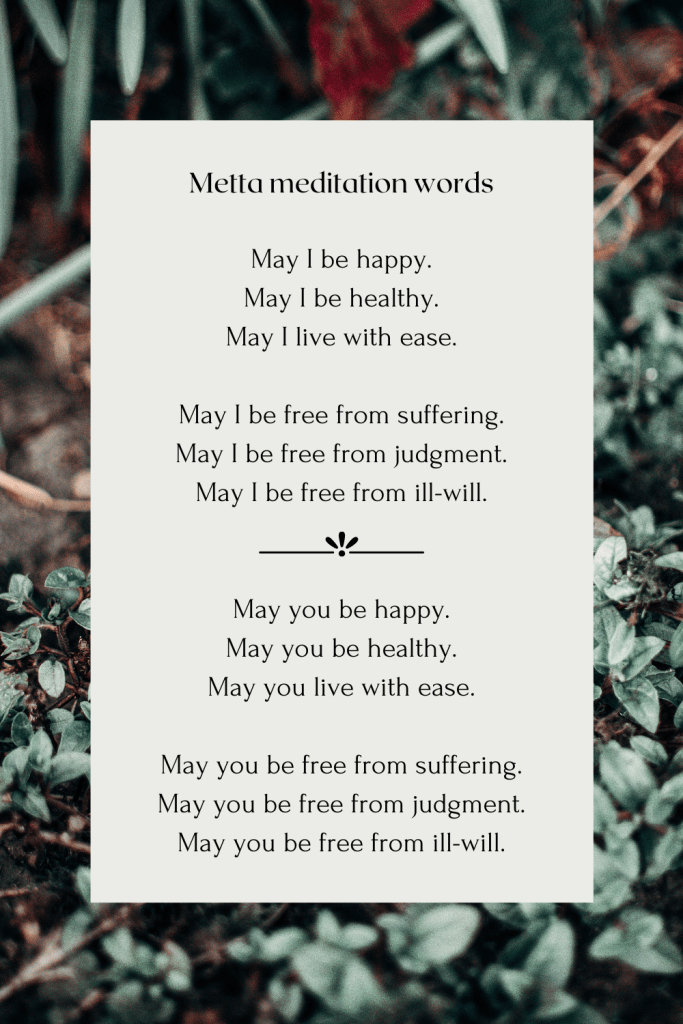
Metta phrases to hold dear
Take a few minutes to read these phrases and observe how they resonate in your mind, body, and heart. Notice if you sense any resistance, without judgement or analysis. Simply be with any sensations that arise.
Guided Meditation (Metta for Oneself, 12 min)

Creative Exercise “Nourishing the Creative Self”

Take 5-10 minutes to free write on this question, without thinking about it too much or evaluating what arises:
What are all the ways you could nourish your creative self in daily life?
After you are done writing, take a moment to reflect on how it feels to envision yourself implementing some of these ideas. Circle one item you can implement in the next week, as a nourishing gift to your inner artist.
An interesting conversation on creativity and mindfulness with bestselling authors Barbara Graham and Hugh Delehanty, and mindfulness teacher Sharon Salzberg who has written extensively on metta:
 The Universe in a Dewdrop